
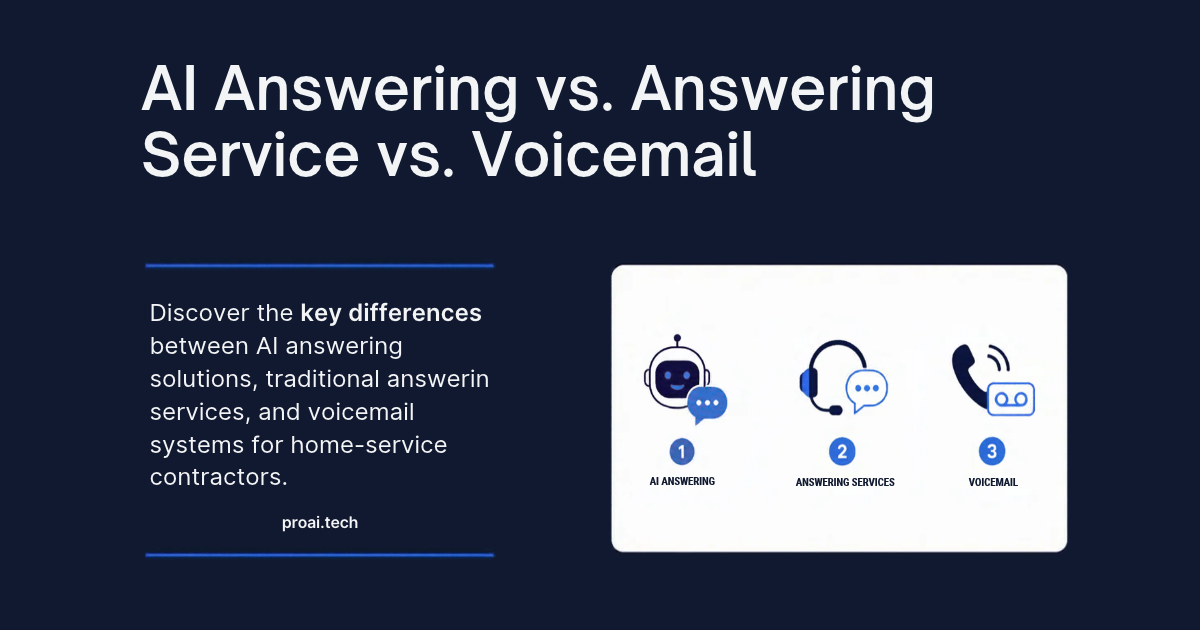
AI Call Answering vs. Answering Service vs. Voicemail: Which Is Right for Your Shop?
The short answer: voicemail is fine for shops with very few calls and no urgent work. A live answering service fits shops that want a human voice and can live with per-minute bills and message-taking. AI call answering fits shops that miss calls regularly, get urgent or after-hours requests, and want every caller captured, qualified and routed without paying by the minute. Which one is right depends on your call volume, how urgent your calls are, and how much setup you want to own.
What happens when a customer calls at 8pm?
Picture a homeowner with a leaking water heater calling your shop after hours. Here’s what each option does with that call.
Voicemail. The caller hears your greeting and decides whether to leave a message. Many won’t. In a September 2025 CallRail survey of 1,000 US consumers, 78% said they had abandoned a business after an unanswered call, and 82% said they would call a competitor instead. Only 42% said they leave a voicemail, and that’s what people say, not what they do.
Live answering service. A human operator answers, reads from a script you provided, takes a message, and sends it to you. Some services can transfer urgent calls or book appointments, usually at a higher price tier. Operators handle many businesses at once, so they rarely know your trade in depth.
AI call answering (do-it-yourself). An AI voice agent answers instantly, asks questions, and sends you a summary. You write the script, set the rules, and test it yourself. Quality depends heavily on how well it’s configured.
Managed AI response (like ProAI Beacon). The AI answers in your company’s name, captures trade-specific details, checks the service area, and follows rules you approved for booking requests, callbacks and handoff to a person. The difference is that the provider configures and tests the setup with you before it goes live, and keeps recordings, transcripts and summaries in one place.
Side-by-side comparison
| What to compare | Voicemail | Live answering service | DIY AI answering | Managed AI (Beacon) |
|---|---|---|---|---|
| Answers every call | No | Yes, within staffing limits | Yes | Yes |
| Available 24/7 | Records only | Often, at premium rates | Yes | Yes |
| Captures trade-specific details | Only if caller leaves them | Depends on script | Depends on your setup | Yes, configured per trade |
| Books or requests appointments | No | Sometimes, higher tiers | If you set it up | Yes, within your rules |
| Hands urgent calls to a person | No | Sometimes | If you set it up | Yes, by your routing rules |
| Call recordings and summaries | Audio only | Message notes | Usually | Yes |
| Setup effort for you | None | Moderate (scripts) | High | Low (guided setup) |
| Typical cost | Included with phone service | $100–$1,000+/month; $0.75–$1.50/minute | $50–$300/month | See plans and pricing |
Industry price ranges are from Nextiva’s 2026 answering service cost guide; see Sources.
When voicemail is honestly enough
If you get a handful of calls a week, rarely do urgent work, and return every call within the hour, voicemail may be all you need. Record a greeting that names your business, says when you’ll call back, and gives an alternative for true emergencies. Then measure it: count how many callers hang up without leaving a message. If that number is small, you’re fine.
When a live answering service is the better fit
A live service makes sense if your callers strongly prefer a human, your call volume is low and predictable, and you mainly need messages taken. Watch the billing: per-minute plans add up fast when trade calls run long, and after-hours or holiday coverage often costs extra. Ask how they bill spam calls and hang-ups before you sign.
Where AI answering works best, and where it doesn’t
AI answering is strongest when calls are frequent, unpredictable, and often come in when your team is busy or closed. It answers immediately, never puts callers on hold, and captures the same details on every call. It’s weaker at judgment calls. A well-built system should not diagnose equipment, promise arrival times, or quote prices you haven’t approved. It should recognize those moments and hand the call to a person under your rules.
Questions to ask any vendor before you sign
- What happens to a call your system can’t handle? Who gets it, and how fast?
- How are urgent calls identified and routed, and who defines “urgent”?
- What details will be captured for my trade specifically?
- Who writes and tests the setup: you or me?
- How am I billed: per minute, per call, or flat? What do overages cost?
- Can I hear recordings and read transcripts of every call?
- Does it answer in my company’s name?
- What won’t it do, and how does it tell the caller?
How to decide
Start with your own numbers. Pull 30 days of call records and count how many calls rang out or went to voicemail, and when. If most misses happen after 5pm, you have a coverage problem. If they happen mid-morning, you have an overflow problem. Then use our Missed Call Revenue Estimator to see what those missed calls may be worth, and compare that against the cost of each option.
Frequently asked questions
Is an AI answering service better than a live answering service?
Neither is better for every shop. AI answers every call instantly and costs less at higher volumes; a live service offers a human voice. For contractors with frequent after-hours or overflow calls, AI with human handoff often covers more calls for less.
Do customers mind talking to AI?
Most callers want their problem captured and a clear next step. A system that answers in your company’s name, asks relevant questions, and connects urgent calls to a person meets that need.
Can I keep my existing phone number?
Yes. Most services, including Beacon, work through call forwarding from your current number, either for all calls or only missed and after-hours calls.
What’s the cheapest option?
Voicemail costs nothing extra, but it’s only cheap if callers leave messages. Compare each option’s cost against the jobs you lose from unanswered calls.
Sources
• Nextiva, “Answering Service Cost: What You Can Expect to Pay in 2026”, updated Sept 23, 2026
• CallRail, consumer survey on missed calls, September 2025, n=1,000 (as summarized by Ainora’s source-checked statistics roundup